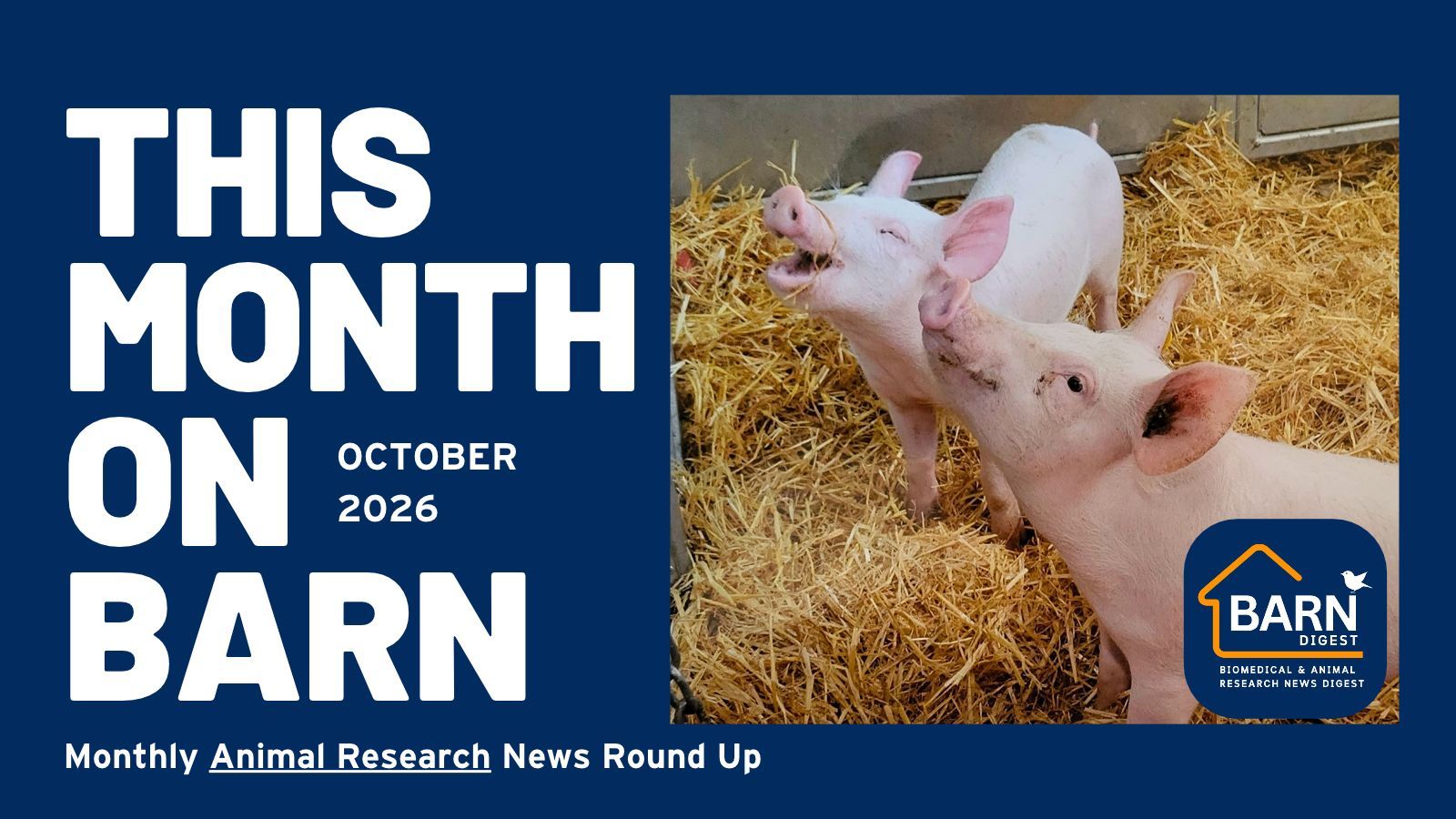
ANIMAL RESEARCH NEWS - OCTOBER 2026
The Biomedical Animal Research News (BARN) Digest collates animal research news from Concordat on Openness signatories and UAR’s 150+ member organisations into one, easy to access, feed. These animal research related stories include topics such as: basic biological research; medical studies and advancements; animal welfare and 3Rs news; funding, regulatory, and policy news; and conservation and environmental research that involves animal testing.
Each month, we pick the most interesting, groundbreaking, and important news to feature in a monthly news roundup.
View BARN to see daily news updates from UAR members.
BASIC/DISCOVERY RESEARCH
New gene-editing approach shows promise in treating Huntington's disease in mice
CARDIFF UNIVERSITY | MICE
"A team of researchers led by Cardiff University has developed a promising new gene-editing approach that could transform the treatment of Huntington’s disease in the future.
In the new study, published in Science Translational Medicine, researchers used a more precise gene-editing enzyme called Cas9 nickase, which cuts only a single strand of DNA within the repeated CAG/CTG sequences in mouse models of Huntington’s disease.
Professor Dion said: “When packaged into viral vectors and delivered directly to the striatum - the brain region primarily impacted by Huntington's disease - in a mouse model, the therapy shortened the DNA repeats in the majority of targeted neurons.
“This led to fewer toxic Huntington protein aggregates, restored healthier gene expression pathways in brain cells, and showed significant improvements in motor function during locomotion tests.”
The team say no unwanted mutations were detected in brain cells in the mouse models with this approach, and it offers a potentially safer alternative to conventional gene-editing methods."
Smoking alters reproductive organs in both men and women, new study finds
UNIVERSITY OF SHEFFIELD | MICE
"A new study, led by researchers from the Universities of Sheffield and Nottingham examined how different levels of cigarette smoke exposure affect the reproductive organs of male and female mice.
Male and female mice were exposed to cigarette smoke extract at a lower or higher dose for 12 weeks. Researchers then examined the structure of the ovaries and testes and measured gene activity in each. The findings offer valuable insight into the biological processes that may help explain how smoking affects reproductive health in humans.
In females, the number and structure of ovarian follicles, where eggs develop, showed relatively little change following exposure, even at higher levels. However, smoke exposure reduced the activity of genes responsible for cell division and metabolism, while increasing the activity of genes that control protein production. These shifts mirror biological changes typically seen in accelerated ovarian ageing and declining fertility in women.
In males, higher levels of smoke exposure led to physical changes inside the testes, including the enlargement of the seminiferous tubules where sperm develop. Genes regulating sperm production become over active, while genes that protect against infection and inflammation became less active. These results suggest that cigarette smoke directly disrupts essential biological processes essential for healthy testicular function and sperm development."
https://sheffield.ac.uk/news/smoking-alters-reproductive-organs-both-men-and-women-new-study-finds
Scientists are a step closer to understanding and extending lifespan
QUEEN MARY UNIVERSITY OF LONDON | WORMS, FLIES
"Scientists have taken an important step towards understanding how the biological processes of ageing might one day be targeted to help people live healthier for longer.
Research involving Queen Mary University of London has found that directly activating AMP-activated protein kinase (AMPK) – an ancient enzyme that helps cells respond when energy levels are low – extended lifespan in three very different organisms: fruit flies, nematode worms and fission yeast.
The study, published in Aging Cell, provides new evidence that AMPK could be a potential target for future research into longevity and healthy ageing."
Clearing ‘immune fog’ could stop lung cancer years before diagnosis
UCL | HUMAN SAMPLES, MICE
"A ‘rising fog’ that may cloud the immune system’s ability to detect tumours, potentially helping lung cancer develop years before diagnosis has been discovered by UCL researchers.
Published in the journal Nature, the research adds to growing evidence that one day cancer could be targeted before it even develops, rather than waiting until the disease causes noticeable symptoms, and in cases of advanced cancer, be harder to treat.
The team carefully studied blood and tissue samples collected from people taking part in long-running lung cancer surveillance and screening studies, while also analysing similar processes in mice, to understand what makes precursors of lung cancer (called pre-cancers or lesions) develop into fully-fledged tumours.
They discovered regulatory T cells (Tregs), a set of specialised cells that form part of the immune system, were gradually building up months or years before cancer develops. Tregs typically hold back other cells in the immune system, pausing their activity, which could be allowing pre-cancers to slip through the cracks and develop into lung cancer unchallenged by the immune system.
Using prototype blood tests, the team found that monitoring the levels of Tregs in the blood could help to identify people at increasing risk of lung cancer or patients with a very early form of the disease.
It also explored using targeted cancer drugs to reverse and disperse the Treg “fog” and found that a drug targeting specific immune processes could reverse the Treg’s immune-suppressing effect, halving the proportion of animals that developed lung tumours in laboratory experiments, and preventing formation of all large tumours."
https://www.ucl.ac.uk/news/2026/oct/clearing-immune-fog-could-stop-lung-cancer-years-diagnosis
Study unlocks key immune cells in pigs to advance vaccine research
THE PIRBRIGHT INSTITUTE | PIGS
"Researchers from The Pirbright Institute have developed new tools to identify and study a critical group of immune cells in pigs that help generate protective antibodies following vaccination and infection. The breakthrough is an important step in using pigs as a model for vaccine development and could help accelerate the design and evaluation of vaccines for both animal and human health.
Published in the Journal of Immunology, the study focuses on T follicular helper (Tfh) cells - specialised immune cells that play a central role in helping B cells produce high-quality antibodies.
“Our study revealed that pig Tfh and Tfr cells share many of the same characteristics seen in humans and mice, highlighting important similarities between species and reinforcing the value of pigs as a model for understanding vaccine-induced immunity.”"
https://www.pirbright.ac.uk/news/study-unlocks-key-immune-cells-pigs-advance-vaccine-research
ANIMAL BEHAVIOUR AND WELFARE
New BBSRC funding to build a foundation AI model that can learn the 'language' of mouse behaviour
SAINSBURYS WELLCOME CENTRE, BBSRC | MICE
"Dr Dario Campagner and Professor Tiago Branco at the Sainsbury Wellcome Centre (SWC) have been granted new BBSRC funding. The award will support the team to create an open-source AI model that recognises and describes patterns in animal behaviour with unprecedented detail. The aim is to better characterise behavioural traits, detect changes over time, compare results across studies, species and mouse models for diseases, and link behaviour to brain activity. The model is expected to benefit neuroscience, preclinical and ecological research.
“Foundation models are extremely powerful because they can learn complex structure from very large and complex datasets, but their success depends on having enough high-quality training data,” said Dr Dario Campagner, Aeon Group Leader and Senior Research Fellow at SWC. “Thanks to the Aeon platform, we have now collected hundreds of billions of frames of mouse behaviour across a wide range of natural and learned behaviours, all recorded in a consistent format. This puts us in a unique position to train a general model of mouse behaviour and, importantly, to make it openly available so that researchers can adapt it to their own experiments and scientific questions.”
Discovery of chicken immune cells could pave the way for more effective poultry vaccines
UNIVERSITY OF BRISTOL | CHICKENS
"A previously unknown population of immune cells in chickens has been discovered by researchers from the University of Bristol Veterinary School in collaboration with The Pirbright Institute. The finding could help transform the way poultry vaccines are developed. The study, published in the European Journal of Immunology, is the first to identify and characterise lipid-reactive Natural Killer T (NKT)-like cells in birds."
Dual-protection vaccine to reduce risk of Nipah virus outbreaks
THE PIRBRIGHT INSTITUTE | PIGS
"The Pirbright Institute is leading an international three-year project funded by the UK Vaccine Network to develop a pioneering bivalent vaccine that protects pigs against Nipah virus and pseudorabies.
Addressing a critical gap in global animal and public health preparedness, the project - Duo-ProTectz - builds on earlier research that showed a vaccine candidate could protect pigs against both diseases.
Nipah virus is a highly pathogenic zoonotic virus that can spread from animals to humans and has been identified by the World Health Organization as a priority pathogen with epidemic and pandemic potential. The most severe recorded outbreak, in Malaysia in 1998 to 99, was linked to pig-to-human transmission and resulted in the culling of more than one million pigs, causing economic losses estimated at £433 million ($582m USD).
Led by Professor Simon Graham, Head of Porcine Reproductive and Respiratory Syndrome (PRRS) Immunology at The Pirbright Institute, the work will focus on demonstrating the vaccine's commercial viability through further manufacturing, safety and efficacy studies, alongside the development of a companion diagnostic test."
https://www.pirbright.ac.uk/news/dual-protection-vaccine-reduce-risk-nipah-virus-outbreaks
REPLACING ANIMALS IN SCIENTIFIC RESEARCH
Pioneering human-relevant approaches across immunotherapy, oncology and gene therapy - NC3RS PRIZE
NC3RS | NON-ANIMAL METHODS
"This year’s International 3Rs Prize recognises advances in complex in vitro models that enable the replacement of animals and generate new insights into human disease.
The Prize recognises a primary research paper, published between September 2022 and September 2025, that contributes to the 3Rs. It is sponsored by GSK as part of its long-standing support of the Prize. With submissions spanning all three ‘Rs’ and representing researchers from the UK, Ireland, Europe and the USA, the breadth and quality of applications made the final decision especially challenging. Alongside the winner, the Panel have also recognised two highly commended publications.
Read about the pioneering human-relevant replacement approaches recognised by this year’s International 3Rs Prize below. Over the coming weeks we will be sharing interviews with our winning and highly commended researchers, discussing the science behind their work, the challenges they have overcome and the impact they are making on replacing the use of animals.
- Winner: Engineering a leukaemia-on-chip platform for more predictive CAR T-cell research
- Highly commended: Replacing animal studies in retinal degeneration gene therapy research
- Highly commended: Moving beyond mice in medulloblastoma research"
Visit BARN for daily news updates

Last edited: 29 October 2026 09:50