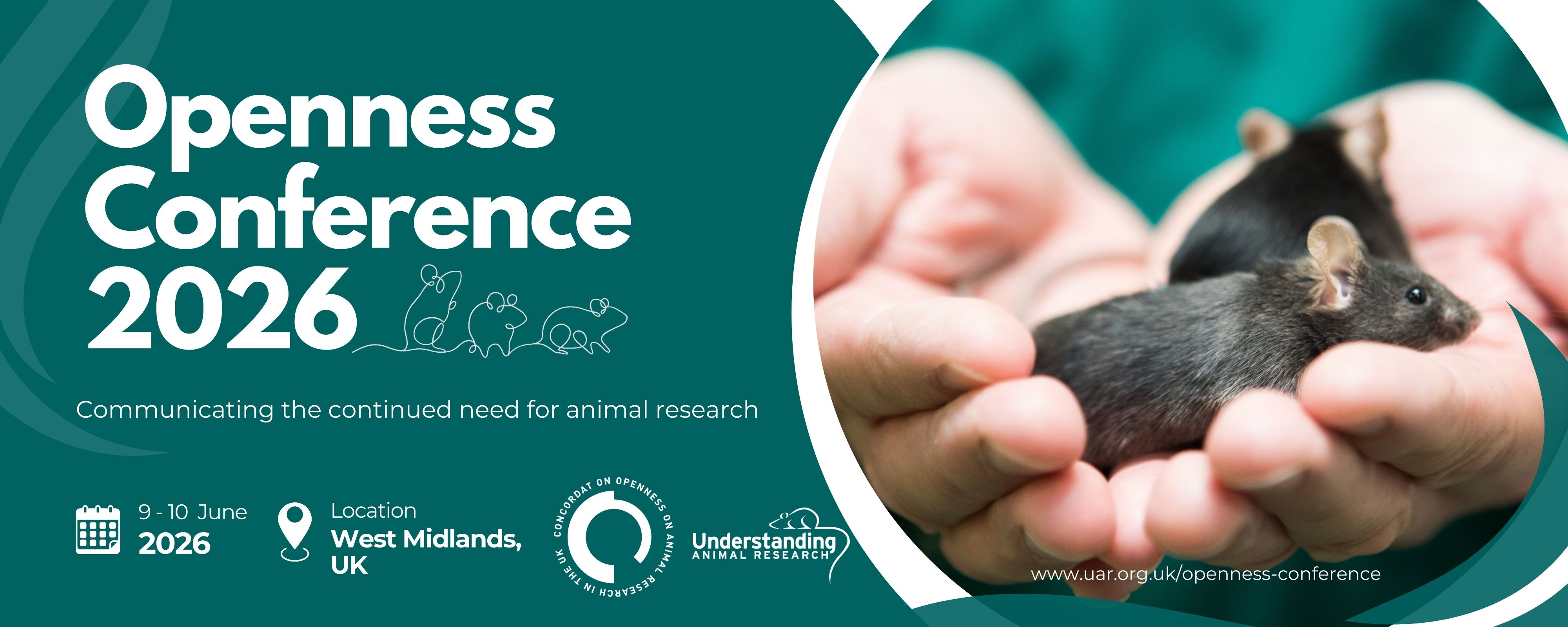
Openness Conference: Communicating the continued need for animal research
9-10 June 2026
West Midlands, UK
The Openness Conference 2026 is your chance to hear about best practices and innovations in openness in animal research, directly from those working in this area.
We are delighted to bring together a wide range of presentations, workshops and posters from scientific communicators, researchers, technical staff, and policymakers supporting openness. The conference is designed for anyone involved with the Concordat on Openness on Animal Research in the UK, or similar openness agreements elsewhere in the world. We hope the conference will be an opportunity for you to engage with experts and learn new skills to help you embed change within your organisation.
We look forward to seeing you in June!
Registration fees
|
Early bird registration for 2-day conference (closed) |
£345 |
|
Standard registration for 2-day conference |
£400 |
|
Conference accommodation based on 1 night bed and breakfast |
£150 |
|
Conference dinner including entertainment |
£60 |

Key dates
|
Registration opens |
February 2026 |
|
Early-bird registration ends |
10 April 2026 |
|
Registration closes |
21 May 2026 |
|
Openness Conference |
9-10 June 2026 |
Stay in touch
Sign up for the Openness Conference newsletter to receive conference news and updates
Programme
Tuesday 9 June 2026 |
|
|
08:00 |
Registration and exhibition open |
|
09:30 |
Introduction and Keynote Wendy Jarrett, Chief Executive, Understanding Animal Research, UK |
|
10:00
|
The future of openness agreements Strengthening Transparency: Engaging Signatories and the Public in New Zealand’s Openness Agreement Ian Saldanha, Australia & New Zealand Council for the Care of Animals in Research and Teaching (ANZCCART NZ), New Zealand
Contributing to a Culture Change: Portugal’s Journey Towards a Transparent and Responsible Animal Research Ana Isabel Santos, NOVA Medical School, Portugal
The German Transparency Agreement: Five years in, reflections and the road ahead Jana Wilken, Initiative Tierversuche verstehen, Germany
Toward Transparency: The U.S. Animal Research Openness (USARO) Initiative & Agreement Paula Clifford, Americans for Medical Progress, USA |
|
11:15 |
Morning Break |
|
11:45
|
Embedding the 3Rs in public engagement: Approaches, opportunities and impact The NC3Rs public engagement award scheme: Supporting grant holders and amplifying reach Genevieve Barr, NC3Rs
An experiential activity to foster people’s curiosity about housing refinements for laboratory mice and rats Carole Fureix, University of Bristol and Chris Handley, Red Kite Vets
Biological Models Top Trumps Joanne Sharpe, University of Sheffield
Animals to organoids – taking the 3Rs to rural communities Eleanor Pearson, University of Exeter |
|
13:00 |
Lunch |
|
14:00 |
Workshops Science writing for lay audiences: non-technical summaries and retrospective assessments Wendy Jarrett, Understanding Animal Research, UK
Advanced media training: workshop participant case studies in animal research Nuno Miguel Gonçalves, European Animal Research Association, UK
Turning conflict into conversation: talking about animal research on social media Mary Harvie and Victoria Summers, Understanding Animal Research, UK
From complex science to simple cards: communicating animal research Alan Dubois, Gircor, France |
|
15:15 |
Poster session Assessment of Laboratory Animal Care and Use in Ethiopian Research Institutes and Universities Henok Ferede Assefa - Armauer Hansen research Institute, Ethiopia
A University of the Third Age visit to an animal facility David Christensen - Mary Lyon Centre at MRC Harwell, UK
Openness in mouse breeding for scientific use: causes of early pup death and routes to refinements Colin Gilbert - Laboratory Animal Science, i3S, Portugal
UAR Resources to Help You Communicate Your Animal Research with the Public Hannah Hobson - Understanding Animal Research, London, UK
What animal models really tell us: lessons from Huntington’s disease Safoora Kakar - University of Leeds, UK
Smartphones really are smart: How to film and edit videos for social media and training. Kirsty Kemp - MRC LMB, UK
Advancing Openness and the 3R’s of Animal Research Through In Vivo Imaging Brittany Koning - Malaghan Institute of Medical Research, Wellington, New Zealand
UAR Oceania: Understanding Animal Research in Oceania and East Asia Bella Lear - Understanding Animal Research Oceania, Australia
Room full of mirrors – how curated content can change your mind Chris Magee - Understanding Animal Research, UK
Outreach in schools John Meredith - Understanding Animal Research, UK
Scaling Transparency: How Imperial’s 3Rs Hub Shapes Communication for Ethical Animal Research Anna Napolitano - Imperial College London, UK
Leaders in Openness: The impact of internal champions on in-vivo openness Aimee Paterson – AstraZeneca, UK
The DFG Senate Commission on Animal Research – connecting science, politics and communication Valeska Stephan - SKTF(DFG)/UMR, Germany
Supporting researchers and building confidence to deliver 3Rs-focused public engagement Emma Stokes - NC3Rs, UK
Hoos’ier Hero? - Reframing Animal Research Communication from Defensiveness to Gratitude Chris Wiederhold - Indiana University, Indianapolis, USA
|
|
16:45 |
Workshops From cage to camera: How to film inside an animal research lab Jamie Yuan and Hannah Hobson, Understanding Animal Research, UK
Rising to the challenge: how to answer the most awkward animal research questions John Meredith, Understanding Animal Research, UK
Embracing Transparency in Animal Research Aimee Paterson, AstraZeneca, UK
Openness for AWERBs Ellie Muscat, RSPCA, UK |
|
18:00 |
Break |
|
19:00 |
Dinner, entertainment, and poster prize giving |
Wednesday 10 June 2026 |
|
|
08:00 |
Registration and exhibition open |
|
09:00 |
Opening Doors Beyond the Lab Tour: Using Spatial Computing and 'Dual-View' AR to Demystify Animal Facilities Maria Kamper and Jo Stanley, University of Manchester, UK
Pigment Experience: An Enriching Art Based Outreach Initiative to Enhance Public Understanding Chris Wiederhold, Laboratory Animal Resource Center - Indiana University, USA
From Classrooms to Cleanrooms: Bringing Students into the Research Animal World Scott Rhodes, University of Otago, New Zealand
Opening the Doors: Practical Approaches to Openness in Animal Research Kirsty Kemp, MRC LMB, UK
Breaking barriers with 360-dgree technology Hannah Hobson, Understanding Animal Research Anna Napolitano, Imperial College London |
|
10:30 |
Keynote Lord Vallance, Minister of State (Minister for Science, Innovation, Research and Nuclear) |
|
11:00 |
Morning Break |
|
11:30 |
Opportunities for two-way engagement Patient Discovery: Expanding patient-researcher dialogue in Europe Inês Serrenho, European Animal Research Association, UK
The Open Forum on Animal Research: an Attempt to Reduce Polarisation in the Netherlands Monique Sundin, European Animal Research Association, UK
Building Research Champions through Structured Educational Framework Cherry May Sanchez, Cancer Research UK Cambridge Centre, UK
It's good to talk: the Whitworth Debate as a model for constructive openness Mike Addelman, University of Manchester, UK
Cultivating Openness: Collaboration, Progress, and Shared Leadership in Animal Research at the University of Washington Sally Thompson-Iritani, University of Washington, USA |
|
13:00 |
Lunch |
|
14:00 |
Engagement with diverse audiences Transparency Agreements in Practice: The Open Week for Public Engagement Monique Sundin and Inês Serrenho, European Animal Research Association, UK
Beyond Breeding: strategic collaboration to anchor the Mauritian NHP Sector in scientific purpose Anupah Makoond, Bioculture Group, Mauritius
Engaging with the public at the Glasgow Science Festival Elizabeth Hurd, University of Glasgow, UK
UAR Oceania Animals in Science Photography Awards Bella Lear, Understanding Animal Research Oceania, Australia
The Quarterly Creature Feature: Chronicling care, commitment and cutting-edge science Lauren Cresser, The Pirbright Institute, UK
Novel initiative to enhance openness and transparency in animal facility management Caroline Bergmann, University of Nottingham, UK |
|
15:30 |
Closing remarks |
|
15:45 |
Close |