The Biomedical Animal Research News (BARN) Digest collates animal research news from UAR’s 150+ member organisations into one, easy to access, feed. These animal research related stories include topics such as: medical studies and advancements; animal welfare and 3Rs news; funding, regulatory, and policy news; and conservation and environmental research that involves animal testing.
Each month, we pick the most interesting, groundbreaking, and important news to feature in a monthly news roundup.
View BARN to see daily news updates from UAR members.
BASIC/DISCOVERY RESEARCH
Targeting the gut's immune system could tackle early stages of Parkinson's
UCL | MICE
"New research reveals how Parkinson’s spreads from the gut to the brain, with the help of immune cells – offering a new potential therapeutic strategy – in a study in mice led by scientists at the UK Dementia Research Institute at UCL.
The research showed that reducing the number of gut macrophages led to reduced spreading of toxic protein, and improved motor symptoms in mice. Published in the journal Nature, and funded by the Chan Zuckerberg Initiative, the study suggests a new potential therapeutic approach for Parkinson’s that could enable intervention long before onset of motor symptoms."
Stroke and “fight-or-flight” response weakens the immune system
UNIVERSITY OF MANCHESTER | MICE, HUMANS
"A new University of Manchester and Edinburgh study published in the journal Brain, Behavior and Immunity has found that people who have had a stroke have fewer of a specific type of immune cell called B cells, which normally produce antibodies to fight off infections. Surprisingly, the same compromising immune changes were seen when healthy B cells were exposed to noradrenaline - a chemical released by the body after stroke, but also during stress, illness, or intense physical activity.
People who have had a stroke are more likely to develop infections such as pneumonia. These infections can slow recovery and make brain injury worse. Understanding why the immune system becomes weaker after stroke could help doctors prevent these infections and improve patient outcomes.
Earlier studies by Dr Laura McCulloch and Dr Barry McColl at the University of Edinburgh found that in animal models, stroke activates the system behind the fight-or-flight response, which includes the release of the chemical noradrenaline."
The switch and the Trojan horse: how viral vectors and synthetic enhancers could change glioblastoma treatment
CANCER RESEARCH UK | MICE
This article explores long-term research into glioblastoma and references mutliple studies in mice which have contributed to our understanding of the disease, including the passage below.
"Introducing a combination of mutations found in human glioblastomas into murine brain stem cells yielded cells that aggressively formed tumours when transplanted into mice’s brains.
One of the things that makes the human disease so deadly – half of people diagnosed with glioblastoma die within 12-18 months, and over 90% within five years – is that the cancers very powerfully evade immune surveillance.
The mouse model replicated this, offering new ways to dissect the escape mechanisms. A glioblastoma, Pollard summarises, becomes full of suppressive macrophages, which are essentially tricked into responding as if it were a healing wound – something that needs to be fixed, not destroyed. Consequently, T cells that ordinarily attack and destroy cancer cells don’t enter the tumour. Or, if they do, the local environment tells them not to kill.
This all suggested that glioblastomas should respond to immunotherapies that mobilise a person’s immune system against their tumour."
ANIMAL HEALTH
Study of uterine inflammation in livestock could help treat infertility in humans
ABERYSTWYTH UNIVERSITY | LIVESTOCK
"Research to help reduce inflammation in the uterus of livestock animals could help pave the way for developing new drugs to treat infertility in women, according to a new scientific review.
Using best ethical practice, scientists at Aberystwyth University have been exploring new ways of treating endometritis in sheep, cattle and other farm animals.
Endometritis causes inflammation in the uterus, bringing discomfort to the animal as well as affecting future fertility and production.
In recent years, there has been a growing recognition that endometritis can also be an important cause of infertility in women.
Researchers hope the recommendations and the knowledge gaps identified in the review paper will help inform understanding among clinical staff treating women with the condition, as well as lead to the development of effective drugs. "
https://www.aber.ac.uk/en/news/archive/2026/01/title-285531-en.html
Pig vaccine candidate outperforms leading available treatment in new trials
UNIVERSITY OF PLYMOUTH | PIGS
"A vaccine developed to tackle Streptococcus suis, an economically damaging disease endemic in the global pig population, has outperformed a leading commercially available vaccine in a challenge trial.
The trial showed the vaccine candidate – developed by an international consortium including The Vaccine Group (TVG), the University of Plymouth and Moredun Scientific Limited – to be effective against a heterologous serotype of the disease."
ANIMAL BEHAVIOUR
Discovery of bats' remarkable navigation strategy revealed in new study
UNIVERSITY OF BRISTOL | BATS
"A long-standing mystery about how wild bats navigate complex environments in complete darkness with remarkable precision, has been solved in a new University of Bristol-led study. The findings are published today [21 January] in Proceedings of the Royal Society B.
While it is well known that bats hunting at night use biosonar (also known as echolocation) to map their surroundings, the question of how they process thousands of overlapping echoes in real time when navigating more complex habitats like forests has long remained a mystery.
To uncover the mechanics behind this extraordinary ability, a team of aerospace engineers and biologists built a custom ‘Bat Accelerator Machine’ to test the theory that bats exploit ‘acoustic flow velocity’ to find their way in more challenging environments."
https://www.bristol.ac.uk/news/2026/january/discovery-of-bats-remarkable-navigation-strategy.html
NON-ANIMAL TECHNOLOGIES
Lab-grown mini-stomachs could boost understanding of rare diseases
UCL | NON-ANIMAL TECHNOLOGIES
"Researchers at UCL and Great Ormond Street Hospital (GOSH) have developed the first-ever lab-grown mini-stomach that contains the key components of the full-sized human organ.
Known as a multi-regional assembloid, the pea-sized mini-stomach is the first to contain the fundic region (the upper portion of the stomach), the body (the central region where food is mixed with acid and enzymes), and the antrum (the lower part of the stomach that breaks down food before entering the small intestine). These components form the mucosa, the inner surface of the stomach, which is essential for acid digestion, protection against auto-digestion and hormone regulation.
In a paper published in Nature Biomedical Engineering, the researchers explain how they isolated stem cells from patient stomach samples and grew them under special laboratory conditions in a petri dish to create mini-stomachs, known as organoids, that mimic the behaviour of a human stomach."
https://www.ucl.ac.uk/news/2026/jan/lab-grown-mini-stomachs-could-boost-understanding-rare-diseases
IMPROVING ANIMAL STUDIES
New AI tool removes bottleneck in animal movement analysis
UNIVERSITY OF ST ANDREWS | TRACKING ANIMAL MOVEMENT
"Researchers from the University of St Andrews have developed an AI tool that reads animal movement from video and turns it into clear, human-readable descriptions, making behavioural analysis faster, cheaper, and scalable across species.
Published today (Wednesday 21 January) by The Royal Society, the PoseR plug has been developed to remove a major bottleneck in neuroscience, psychology and biology to enable larger faster, and more reproducible studies. "
https://news.st-andrews.ac.uk/archive/new-ai-tool-removes-bottleneck-in-animal-movement-analysis/
Visit BARN for daily news updates

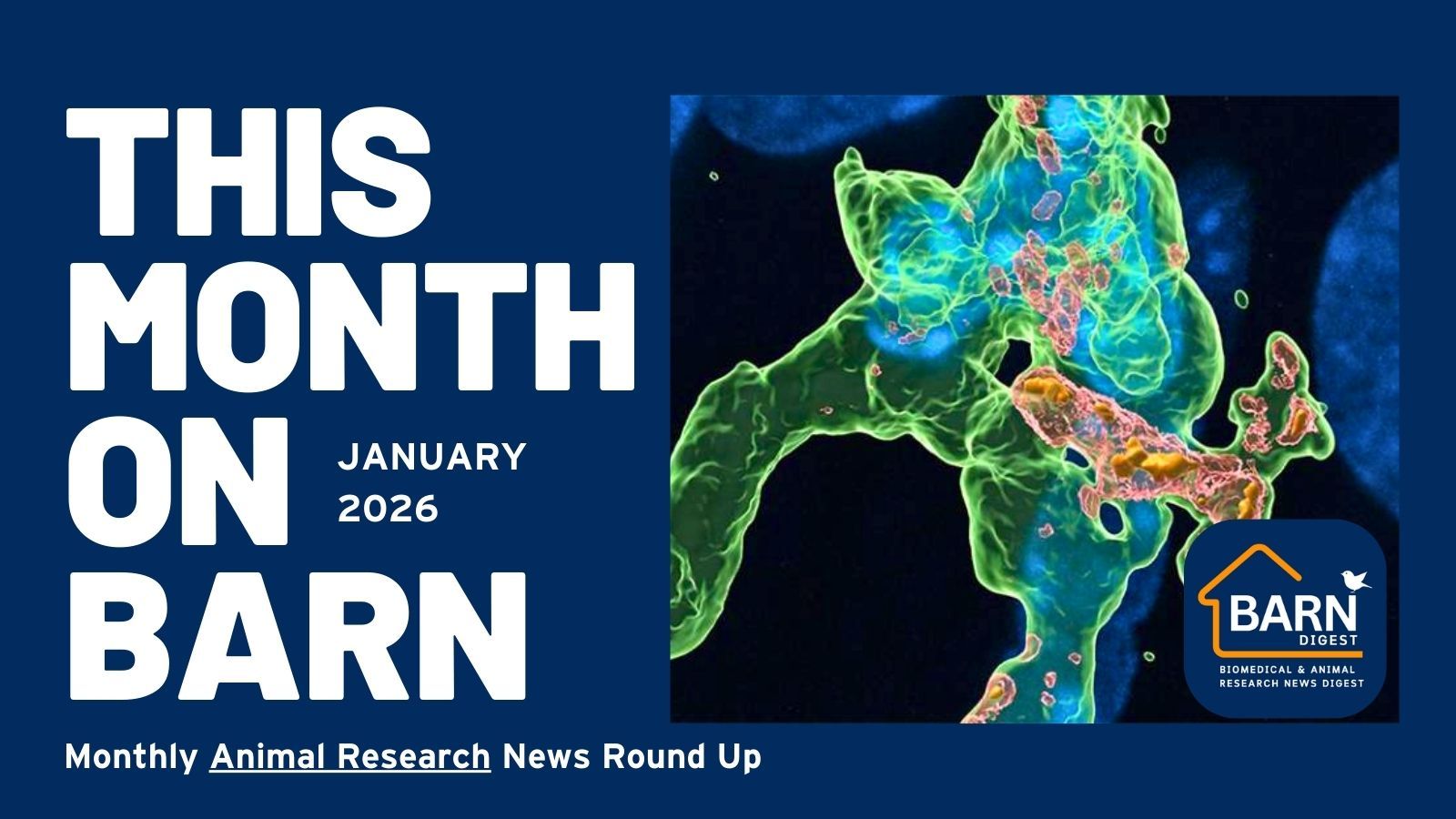
Image used in cover photo: A macrophage (immune cell) engulfing the toxic alpha-synuclein protein. Credit: Hong/Bartels Lab, UK DRI at UCL.
Last edited: 29 January 2026 12:01