Polio
Polio was once a major global health threat, causing widespread illness and disability in communities around the world. The virus can spread through contaminated food and water, and although most infections cause no symptoms, severe cases can affect the nervous system and lead to lifelong paralysis. Paralysis can also affect the muscles needed for breathing, contributing to a mortality rate of around 10% among people who develop paralytic polio.
Evidence suggests that polio has affected humans for thousands of years, with ancient carvings and prehistoric remains showing physical characteristics consistent with the disease. The poliovirus itself, however, was not discovered until 1908, when researchers Karl Landsteiner and Erwin Popper used monkeys, mice and rats in experiments that demonstrated how the virus could be transmitted. Their work marked an important early step in more than a century of research that has brought the world close to the eradication of polio.
Since the development of polio vaccines, cases have fallen dramatically worldwide. Between 1988 and 2021, the number of reported cases decreased by more than 99.9%, from an estimated 350,000 to just six.
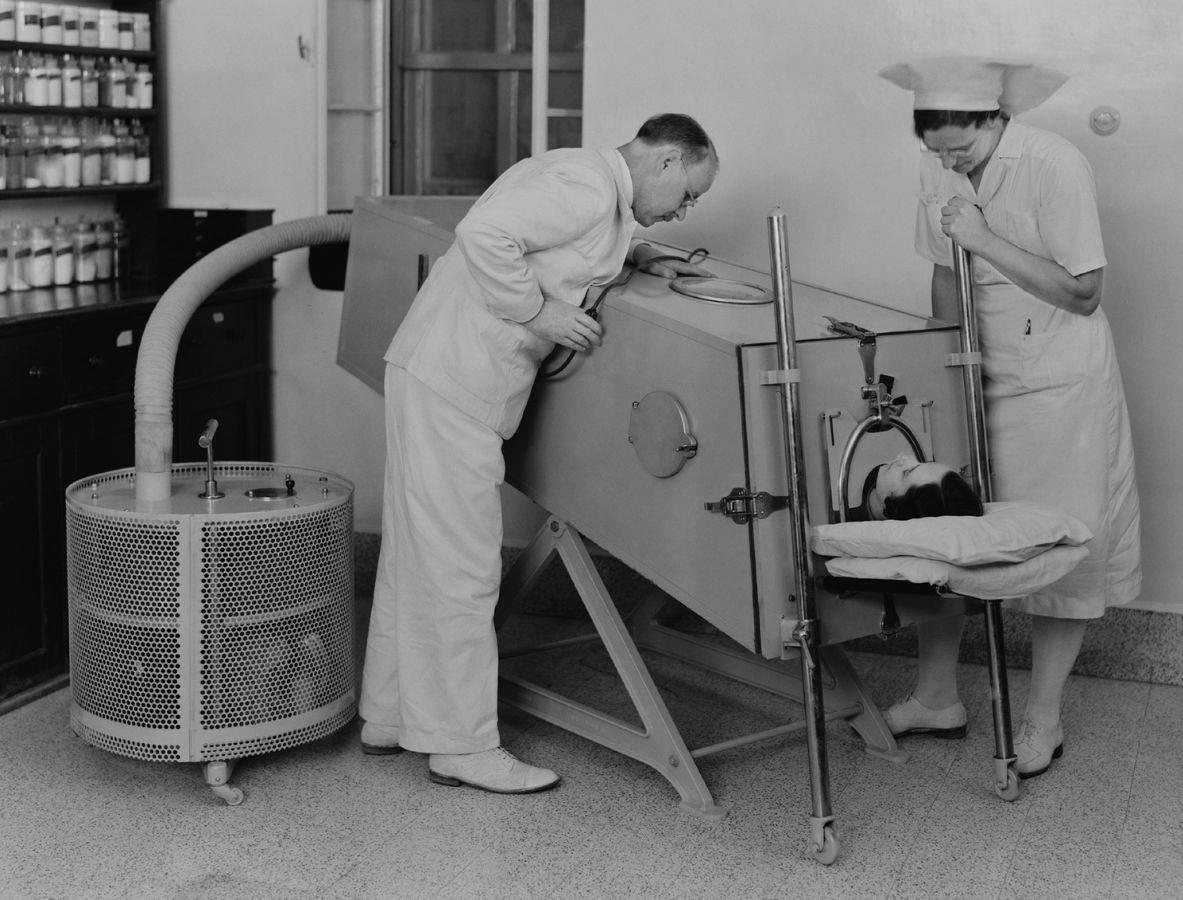
Polio patient in an iron lung at the Scots Mission Hospital in Tiberias, Palestine in March 1940.
What is Polio?
Polio, or poliomyelitis, is a highly infectious disease caused by the poliovirus. It primarily affects children under five years old. The virus spreads mainly from person to person through contact with infected faeces, and less commonly through contaminated food or water. Once inside the body, the virus multiplies in the intestine and, in some cases, can infect the nervous system and cause paralysis.
Most polio infections are asymptomatic, with around 70% to 95% of people developing no symptoms. In 5% to 25% of cases, people experience mild, flu-like symptoms such as a sore throat, fever and headaches. In less than 1% of cases, the poliovirus affects the brain and spinal cord, causing severe pain, muscle weakness and, in some cases, paralysis.
How can we treat Polio?
The primary method of defence against polio is vaccination. Because no cure exists for polio, the only option for patients is to manage their symptoms by providing pain relief and breathing support. Bed rest and physical therapy are also key elements of managing the disease.
How has animal testing contributed to our understanding of polio?
Early attempts to develop a polio vaccine were largely based on trial and error. In 1935, vaccines developed by Maurice Brodie and John Kolmer were tested in people before modern safety standards were in place. Several children developed acute paralysis and at least five died, although it remains unclear whether the deaths were caused by inadequately inactivated virus or because the vaccines failed to protect against infection.
By the 1940s, polio was paralysing or killing around half a million people worldwide each year. A major breakthrough came in 1948, when John Enders, Thomas Weller and Frederick Robbins succeeded in growing poliovirus in non-nerve human tissue. They confirmed that the cultured virus remained infectious using mice and monkeys, and their work later earned them the 1954 Nobel Prize in Physiology or Medicine.
Being able to grow large quantities of poliovirus transformed vaccine research. Building on this work, Jonas Salk and Albert Sabin developed the polio vaccines that are still used today. Their approaches differed, but both relied extensively on animal research.
Read more about the animal research behind polio vaccines in “A disease on the brink of eradication: how animal research led to polio vaccines”.
Future research into polio
Current polio research is focused on developing safer and more affordable vaccines. In 2025, researchers at the University of Leeds made progress towards this goal using virus-like particles (VLPs). These particles mimic the outer protein shell of poliovirus but contain no viral genetic material, meaning they can trigger an immune response without any risk of causing infection.
In the University of Leeds study, they used female Wistar rats to test the effectiveness of VLPs generated using yeast, insect, mammalian and plant cells. They found that the VLPs generated immune responses that were comparable to, or greater than, those produced by the current inactivated polio vaccine (IPV).
Read more about polio and vaccines: