
One hundred years ago, tuberculosis (TB) was one of the leading causes of death worldwide. Today, while the overall number of cases has dropped, TB has re-emerged as the world’s leading killer from a single infectious agent, overtaking COVID-19 in 2023, according to the World Health Organization (WHO). Despite existing vaccines and therapies, the disease remains a significant public health issue in Europe. The region is falling behind elimination targets, according to a new joint report by the WHO and the European Centre for Disease Prevention and Control (ECDC).
TB is an infectious disease caused by strains of bacteria from the mycobacteria family. The disease most commonly affects the lungs and can be fatal if not treated. Despite being preventable and curable, Mycobacterium tuberculosis, infects about 25% of the global population, with an average of 5–10% progressing to symptomatic disease. In 2024, that led to 1.23 million deaths in the world. Progress towards elimination remains insufficient.
In Europe, one in five cases of tuberculosis still goes undiagnosed, representing not only a failure in detection, but a missed opportunity to treat patients earlier, prevent suffering, and stop further transmission. Moreover, drug resistance in the region remains higher than in other parts of the world, according to the new WHO–ECDC report. Multi-drug resistant tuberculosis among new and previously treated cases was 23% and 51% respectively, which significantly exceeds the global average of 3.2% and 16%. The United Nations High-Level Meeting on antimicrobial resistance has recognised drug-resistant TB as a critical component of the global antimicrobial resistance response. These antibiotic resistant variants require longer treatments with more drugs and are associated with lower success rates.
“There remains a significant unmet need for new tuberculosis treatments in the EU, especially for children,” said Emer Cooke, the EMA’s executive director in Science | Business.
Eradication efforts are hindered by slow research and innovation, as well as a lack of essential tools, from vaccines to diagnostics and medicines. Only one licensed TB vaccine is currently in use (BCG), and it was developed more than a century ago. “By investing in rapid diagnosis, shorter all-oral treatment regimens and stronger follow-up, countries can reach more people, earlier, improve outcomes and put us back on track toward our targets,” said Hans Kluge, WHO Regional Director for Europe.
After decades of stagnation, the rise in TB cases is pushing innovation in the sector, and driving the largest TB drug and vaccine pipeline in history. There are currently 29 candidates in clinical development, including 18 next-generation or new chemical entities (NCEs) and eight repurposed drugs. All of these have involved animal research (see table below).
A selection of leading candidates from the TB drug and vaccine pipeline
|
Agent |
Type |
Trial |
Stage |
Animal Research |
|
LAI-bedaquiline |
Long-acting injection |
Phase 1 |
||
|
TBA-7371 |
NCE |
Phase 2 |
Mice, |
|
|
BTZ-043 |
NCE |
Phase 2 |
||
|
Ganfeborole |
NCE |
Phase 2 |
||
|
Telacebec |
NCE |
Phase 2 |
||
|
SQ-109 |
NCE |
Phase 2 |
||
|
Delpazolid |
Next-generation drug (oxazolidinone) |
Phase 2 |
||
|
TBAJ876 |
Next-generation drug (diarylquinoline) |
Phase 2 |
||
|
Quabodepistat |
NCE |
Phase 3 |
||
|
M72/AS01E |
Adult vaccine (recombinant protein) |
Phase 3 |
mice, guinea pigs, rabbits and monkeys, Mice, guinea pigs, Mice, guinea pigs, cynomolgus monkeys, monkeys, Mice |
|
|
MTBVAC |
Adult vaccine (attenuated virus) |
Phase 3 |
Rhesus macaques, mice, guinea pigs, guinea pigs, newborn mice, mice, mice, non human primates, discovery, report, guinea pigs, mice |
|
|
Immuvac |
Adult vaccines (inactivated virus) |
Phase 3 |
Mice, mice, mice, mice, guinea pigs, guinea pig |
|
|
Sutezolid |
Next-generation drug (oxazolidinone) |
Phase 3 |
Non human primates, mice, mice , non human primates, mice, mice, mice, summery, development |
|
|
Sudapyride |
Next-generation drug (diarylquinoline) |
Phase 3 |
Zebrafish, monkey, beagle, rat, and mouse liver, in vivo, mice ,mice, mice, |
doi: https://doi.org/10.1038/d41591-026-00019-1
Animal models are essential tools to mimic the clinical symptoms observed in human TB and to study immune responses to infection and the pathophysiology and pathogenesis of TB. Since Robert Koch in 1882 first used guinea pigs to prove that Mycobacterium tuberculosis caused TB, various animal models –including mice, rats, rabbits, guinea pigs, cattle, zebrafish, non-human primates, and others –have been used to study various aspects of TB and evaluate new therapies and vaccines. No single model fully represents all aspects of the disease due to considerable differences in disease resistance, susceptibility and route of infection. Nevertheless, together these animal models have significantly contributed to drug and vaccine development, identification of biomarkers, and understanding of TB immunopathogenesis and the influence of host genetics on infection.
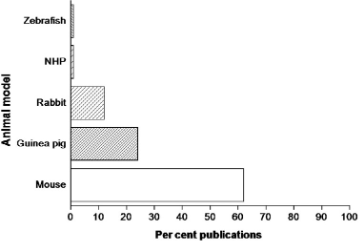
Histogram showing proportion of different pre-clinical animal models used in TB research. Search terms either mouse or guinea pig or rabbit or non-human primate (NHP) or Zebrafish with tuberculosis were used for searches on PubMed on March 12, 2018. Source : https://pmc.ncbi.nlm.nih.gov/articles/PMC6094516/
Last edited: 19 May 2026 14:18