This article was originally published in German by Tierversuche Verstehen. 
We spend a third of our lives asleep and yet we still don’t know why. It is well known that the body regenerates during sleep, that memories are transferred to long-term memory, and the immune system's defences are strengthened, but why we need to be asleep to do these things and what triggers it remains a mystery, although recent research on a tiny fruit fly may be about to provide some answers.
By studying the minuscule brain of the fruit fly Drosophila melanogaster, researchers at the University of Oxford have discovered that sleep is a necessary bodily response to mitochondrial metabolism.
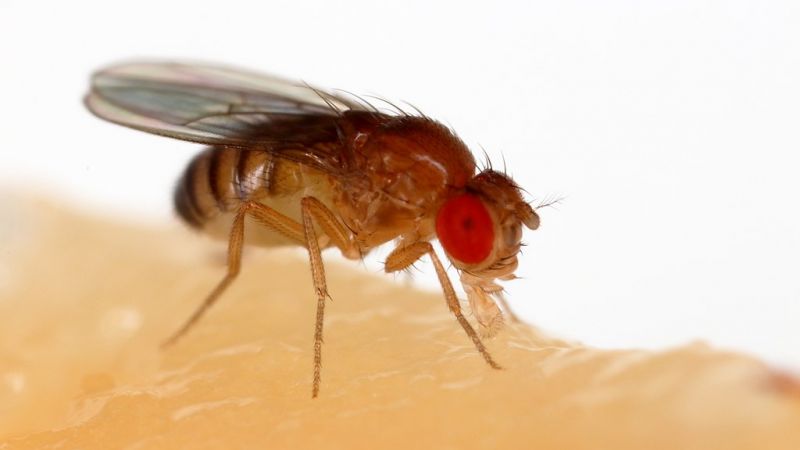
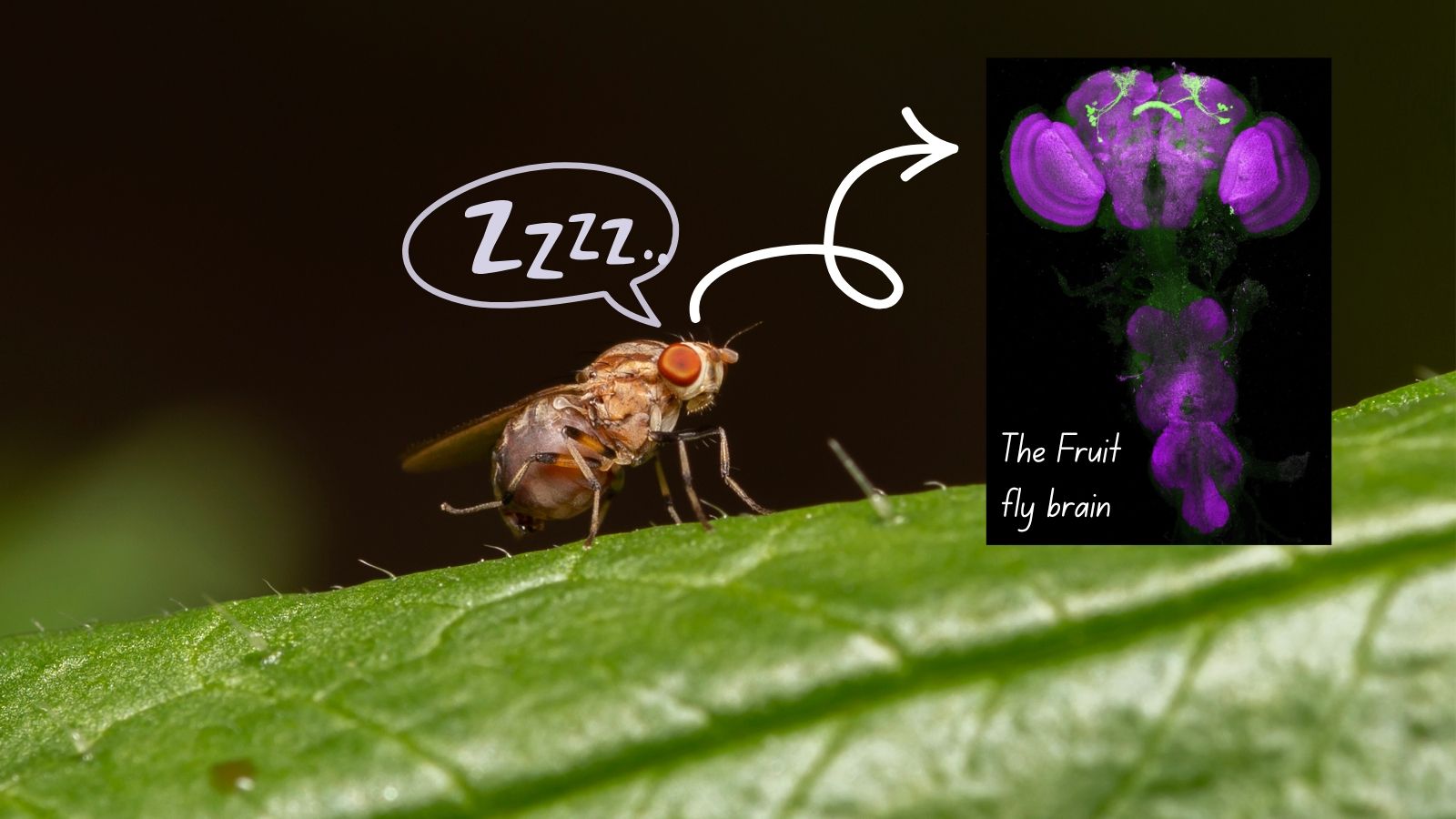
At just 0.25 mm, the fruit fly brain is significantly smaller than ours, yet these little insects exhibit a range of complex behaviours. And they sleep too. Fly sleep shares many similarities with human sleep. Just like us, flies sleep at night and are active during the day. Neuroscientist Gero Miesenböck explains what else makes the fruit fly so suitable for sleep research: "Most relevant parts of the fly brain are visible under the microscope. The scale of the biological structure and that of our analytical methods, which operate at the level of individual cells, align well."
The sleep-related thermostat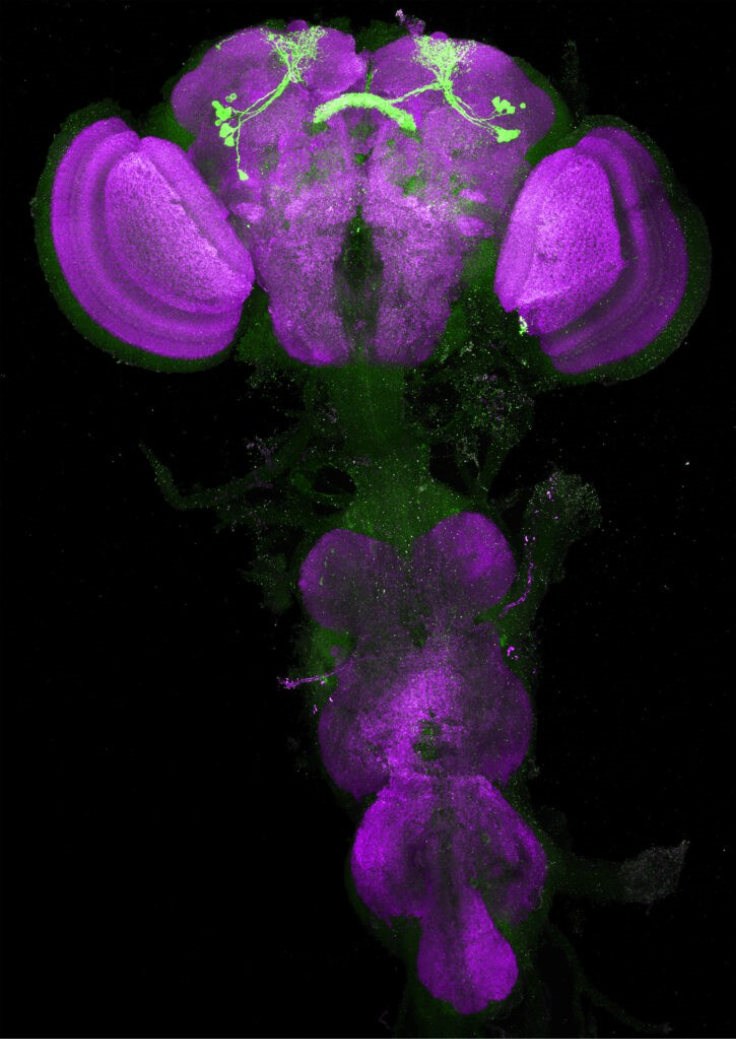
Gero Miesenböck has significantly shaped modern neurophysiology with his methodological developments. As a co-founder of optogenetics, he investigates the relationship between sleep and the metabolism of mitochondria – the organelles within most of our cells that provide them with energy. Together with his team at the University of Oxford, he aims to identify the molecular mechanisms underlying the urge to sleep. To this end, the researchers compared the brains of well-rested flies with those of flies that had been deprived of sleep. They analysed which genes were activated in the nerve cells of each. In the sleep-deprived flies, they made a crucial observation: genes important for mitochondrial respiration and energy production were active in certain nerve cells.
However, this effect was not present in all nerve cells of the tired fly brain. The nerve cells in which the genes were particularly active therefore play a special role in sleep regulation. These sleep-regulating nerve cells in the fruit fly brain are called the "dorsal fan-shaped body" (dFB). Miesenböck explains the function of the dFB as the thermostat of sleep, the switch that forces the transition into sleep. The metabolism in the mitochondria can be understood as the biological equivalent of temperature. When a threshold is reached, the thermostat flips the switch, and sleep pressure increases.
Image right: Microscopic image of the brain of a fruit fly (Drosophila melanogaster), Centre for Neural Circuits and Behaviour, University of Oxford
Electron buildup as a sleep signal
 The direct link between sleep and mitochondrial metabolism was first demonstrated in a 2025 study by Gero Miesenböck, published in Nature. Mitochondria are commonly considered the "powerhouses" of the cell. During cellular respiration, electrons are transported within their inner membrane to store energy in the form of a chemical compound (ATP). This process runs at full speed, especially during waking hours when cells are highly active. However, individual electrons repeatedly escape from the transport chain, resulting in a so-called electron buildup in the inner mitochondrial membrane.
These “free” electrons can react with oxygen to form a byproduct called reactive oxygen species (ROS), which are toxic to cells. Cells with a high metabolic rate, such as nerve cells, are particularly susceptible to this burden. The more these byproducts build up, the more damaging it is for the cell. However, the amount of toxic ROS in the mitochondria plays a crucial role: it signals to the nerve cells in the dFB region when sleep is needed. Miesenböck showed that ROS directly regulate the activity of these nerve cells and thus trigger the urge to sleep.
In sleep-deprived flies, genes for mitochondrial respiration and ATP production were increasingly activated in the dFB region. This activation is a direct response to oxidative stress. It serves to support the respiratory chain and thus reduce electron buildup and its harmful effects. To investigate this mechanism, the researchers specifically manipulated the respiratory chain in the mitochondria of the flies. When electron buildup was resolved, the flies slept less and remained active despite long periods of wakefulness. Conversely, artificially mimicking electron buildup and the associated formation of harmful reactive oxygen species caused even well-rested flies to sleep more.
Image right: Professor Gero Miesenböck researches the connections between sleep and mitochondrial metabolism, Centre for Neural Circuits and Behaviour, University of Oxford
From fly brain to human
The question remains whether this mechanism also applies to the brains of mammals. Miesenböck says: "I think so, but that still needs to be proven." However, there are indications that it does. Studies show a link between sleep deprivation and mitochondrial changes in humans.
Unlike our internal clock, which regulates when we sleep, the newly discovered mechanism explains why we get tired in the first place. According to this research, tiredness is a reaction of the body to counteract the buildup of electrons in the mitochondria. The other functions of sleep, such as the processing of memories, could possibly be side effects of this process. So research on fruit flies provides a possible molecular cause for the need for sleep which may apply equally to humans.
Footnote: Experiments with Drosophila are not considered animal experiments in the legal sense, as invertebrates (with the exception of cephalopods) are not covered by the EU Directive on the protection of animals used for scientific purposes. This means researchers can work with Drosophila without a government licence.
In the UK experiments on vertebrate animals and cephalopods are regulated under the Animals (Scientific Procedures) Act 1986 (ASPA). Experiments on invertebrates, including Drosophila, are not regulated by the UK government.
Further information
https://www.the-scientist.com/animals-sleep-because-electrons-leak-73356
https://www.nature.com/articles/s41586-025-09261-y
https://www.cncb.ox.ac.uk/people/gero-miesenboeck
(GER) https://www.mdr.de/wissen/medizin-gesundheit/mitochondrien-regeln-beduerniss-zu-schlafen-102.html
Last edited: 30 July 2026 10:04